Showing posts with label China. Show all posts

Monday, December 4, 2006

China ordains Catholic bishop without Vatican approval

In this previous post, I discussed the Chinese government's attempts to assert control over Tibetan Buddhism by taking over the process of choosing the next incarnation of Tibetan Lamas.

The Chinese government also ordains its own Catholic bishops without Vatican approval. From The New York Times:
China and the Vatican exchanged renewed criticisms over the weekend about China’s selection of a new bishop over the Vatican’s objections, but there were hints on each side that the dispute might be papered over in the months ahead.

[...]

The Vatican said in a statement on Saturday that Pope Benedict XVI was “deeply pained” by the ordination of Wang Renlei [王仁雷] last Thursday as a bishop in Xuzhou [徐州] Diocese in Jiangsu [江蘇] Province in eastern China. The statement was slightly shorter and slightly less condemning than the one issued when the state-approved mainland church consecrated two other Chinese bishops last spring over the Vatican’s objections; a statement at that time said the pope “has learned of the news with profound displeasure.”

The pope warned then of the excommunication of the two bishops, Liu Xinhong [劉新紅] and Ma Yinglin [馬英林], although the Vatican has not begun the paperwork for such an action. In his statement on Saturday, he cited the same section of canonical law that includes excommunication for clergy who defy the Vatican. The Vatican’s statement was less directly critical of Beijing than the statement issued here late Thursday night by Cardinal Joseph Zen [陳日君], who is the bishop of Hong Kong and the only Chinese cardinal. He accused the Chinese government of kidnapping clergy and forcing them to participate in the consecration on Thursday, and he said the government sought to disrupt the unity of the Roman Catholic Church.

Liu Bainian [劉柏年], the vice president of the Chinese Patriotic Catholic Church Association [中國天主教愛國會], which oversees the government-approved mainland church, denied in a telephone interview that anyone had been kidnapped or coerced. He also provided further details of the selection of Wang Renlei to become the auxiliary bishop of the diocese. [...]
China has a history of religiously inspired rebellions, and the loyalty of large numbers of Chinese citizens to any organisation outside of state control makes the Communist Party very nervous.

南無阿彌陀佛

Sunday, November 19, 2006

Cutest. Lama. Ever.


From Buddhism-Online:
Four-year-old Goinbo Dungzhi has been enthroned as the seventh Kungtangcang living Buddha and the reincarnation of the sixth who died in 2000, said officials in a Tibetan community of northwest China's Gansu Province on Thursday.

A grand enthronement was held at the Labrang Lamasery in Xiahe county of the Gannan Tibetan Autonomous Prefecture on Monday in line with the rituals of Tibetan Buddhism.

[...]

The sixth Kungtangcang Danbawangqu living Buddha, who died aged 75, was enthroned in 1931 when he was six years old. He was a member of the National Committee of the Chinese People's Political Consultative Conference, China's top political advisory body, and vice president of the Buddhist Association of China.
There are basically two sets of Tibetan Buddhist Lamas — one loyal to the Dalai Lama, and a parallel one loyal to China.

When the tenth Panchen Lama passed away, the Communist government of China kidnapped the child recognised by the Dalai Lama as the eleventh Panchen Lama, and enthroned its own appointee instead. This is significant because the Panchen Lama is responsible for finding the next incarnation of the Dalai Lama.

By asserting control over the process of selecting the next incarnation of Tibetan Lamas, the Communist government is gradually taking over the Tibetan Buddhist religious hierarchy. The seventh "Kungtangcang living Buddha" will undoubtedly be carefully taught by the Communists to toe the Party line.

南無阿彌陀佛

Saturday, November 18, 2006

Shaolin Football

There was a movie from Hong Kong a few years ago that was quite popular called Shaolin Soccer (IMDB entry). The movie starred Hong Kong comedy legend Stephen Chow [周星馳] as a down-on-his-luck disciple of Shaolin kung fu [少林功夫] who popularises the martial art by combining it with soccer.

In a case of life-imitates-art, Venerable Shi Yongxin [釋永信], the abbot of Shaolin temple [少林寺] (whom we have previously met in this post), plans to develop a football program there. But by "football" I am referring to American football here, not to what is called "soccer" by Americans.

From Buddhism-Online:
In the days following his first experience with American football, Abbot Shi Yongxin, leader of the Shaolin Temple in China, is developing plans to start a football program at the Temple.

In an effort to promote cultural exchange, the Abbot's goal is to develop a series of football teams that would tour the United States and play exhibition games. The names of the teams would mirror current American football teams.

[...]
Thank the gods that the high school team in Pekin, Illinois, long ago changed their name to the Pekin Dragons.
As part of the plan, the [United States Sports Academy] would provide football coaches and administrators to train athletes and build a program at the Shaolin Temple. For over 30 years, the Academy has delivered sports programs in more than 60 countries around the world. [...]

A 10-part certification program to teach Kung Fu and other martial arts is also being developed as a joint effort between the Academy and the Abbot.

The United States Sports Academy is an independent, non-profit, accredited, special mission sports university created to serve the nation and the world with programs in instruction, research and service. The role of the Academy is to prepare men and women for careers in the profession of sports.
In traditional Chinese Buddhism, kung fu is not considered a sport, but is one component of an integrated program of mental, spiritual, and physical training, the aspects of which are inseparable from one another. Of course, the physical training had long ago been separated from the rest, resulting in many schools of martial arts most of which have nothing to do with spirituality. But one would hope that the Shaolin temple of all places would try to maintain the traditional stance.

南無阿彌陀佛

Monday, November 13, 2006

Dalai Lama seeks China democracy

No surprise there. From Yahoo News:
TOKYO - Tibet's spiritual leader, the Dalai Lama, told a Japanese opposition party politician that democratization would make China a more predictable neighbor, a news report said Saturday.

The Dalai Lama, ending a 14-day visit to Japan, said surrounding countries have difficulty knowing what actions "the big dragon" — referring to China — will take, Kyodo News agency said.

According to the Japanese lawmaker, Yukio Edano of the Democratic Party of Japan, the Dalai Lama said China would become predictable if it democratized and "the dragon will become calm," Kyodo reported.
Yeah, what the big dragon really needs is a little sitting meditation.
The Japanese government allowed the Dalai Lama to enter Japan on the condition that he not engage in any political activities.
The man is a political activity.

I'd actually like the Dalai Lama to be more political. I would like to hear what he has to say, as a spiritual leader, on important global political topics. But aside from the issue of Tibet, he has tended to shy away from controversy.

南無阿彌陀佛

Sunday, November 12, 2006

"Reformation of Islam" aberrant?

Someone (based on the context, a Muslim) calling himself (or herself) "God's Servant" left a comment yesterday on this post from October:
There is no reformation of Islam, it's impossible. Actually Islam is declining, modern time of Islam existed 14 centuries ago while other civilizations and religions were in darkness, that's why the expression "reformation of Islam" is aberrant.

Nowadays, even muslims don't know nothing about their religion and they are the first victims of fanatism and terrorism existed in muslim countried before existing in the west.

Islam is like money, you got to work hard to find the truth.
I didn't want to reply just in that post, since it's over a month old, so I'll reply here in this new post. I specifically want to address this claim:
modern time of Islam existed 14 centuries ago while other civilizations and religions were in darkness
This is a myth perpetuated by apologists for Islam, and it is simply not true. Persia (Iran), India, and China were all enjoying relatively high degrees of civilization at the time of the advent of Islam. Buddhism had been transmitted from India to China over the previous several centuries and was fomenting an intellectual revolution along its routes of transmission. The disintegration of many of these highly developed societies was in fact caused by the relentless waves of Muslim invasions.

One of the major reasons for the initial successes of Islam was that the early Muslim conquerors assimilated the civilizations of the peoples it conquered. The first Arab-Islamic conquests were facilitated by the fact that the Byzantines and the Sassanians had exhausted themselves fighting against each other. When the Muslims conquered Persia, they essentially adapted the pre-existing structures of governance and methods of statecraft of the Persians. They recruited Persian scholars to their cause and employed many Persian administrators to run the Islamic empire. They similarly assimilated the knowledge of various smaller communities living under Islamic rule by the appointment of their scholars to court and through the conversion of their members to Islam. (Try looking into the ethnic backgrounds of the most influential philosophers, scientists, and other scholars in the Islamic world at this time.)

If it had not been for Persian administrative practices and experience, Greek medicine and philosophy, Indian mathematics and metallurgy, Chinese papermaking technology, and a host of other sciences and technologies captured or learned from others — not to mention Jewish, Christian, and Zoroastrian religious beliefs and practices — there would have been no Islamic civilization. The Islamic empires were built upon ideas copied from neighbouring civilizations and with the wealth obtained through their conquest and plunder.

Yes, the Muslims were at one time leaders in civilization, but it wasn't quite 14 centuries ago. It was several centuries afterward, after Islam had established itself more or less securely in Persia and Central Asia and was making its way across India. But as the Islamic empires expanded and dhimmi populations were converted to Islam, the policy of continual military expansion pursued by Islamic rulers started to become uneconomical. At the same time, influential Muslim theologians popularized the idea that Islam represented the height of civilization and that other societies were in darkness, and Muslims began to cease learning from other cultures. These internal developments, coupled with external events such as the irruption of the Mongol hordes, marked the beginning of the decline of Islamic power.

The myth that the first generation of Muslims had attained the pinnacle of civilization seems to explain the success of the Islamic empires relative to their competitors at this time, as well as their subsequent decline. I suppose that's why it's popular among Muslims. But an examination of the historical evidence shows that this myth is false. Belief in this myth – which can only be described as hubris – is precisely what led to the downfall of Islamic societies to begin with, and is one of the major factors preventing Islamic societies from adapting or developing modern concepts of individual rights.

Islam is indeed in decline, and has been for centuries. Most of the Islamic countries in the world cannot support themselves and would collapse if not for oil (Saudi Arabia, Iran), massive amounts of foreign aid (Egypt, Pakistan), or a sizeable non-Muslim population that is wealthy and industrious (Indonesia, Malaysia). This state of affairs will not be sustainable for very much longer. You wrote that 'the expression "reformation of Islam" is aberrant', but the way things are going, the alternative to reformation is destruction.

You seem to be suggesting that the only real Islam was practised 14 centuries ago and that what is needed is not a reformation but a return to some pristine ideal. The problem is that this ideal exists only as a myth, invented centuries after the fact. To base one's actions on such a false view of the world is to act under the influence of ignorance (or delusion), one of the "three poisons" in Buddhist philosophy. What is needed among Muslims is not more blind adherence to religious dogma and mythology, but a genuine understanding of real history.

(By the way, I skimmed through your blog. It seems to consist of nothing more than parroting other people's poorly reasoned Islamic apologetics. For a critic's view of these arguments for Islam, I recommend a visit to Freethought Mecca.)

南無阿彌陀佛

Saturday, October 21, 2006

Shaolin Temple to become Buddhist Disneyland

I wrote about the commercialization of Buddhism in China in this previous post.

One of the central characters in this drama is the Venerable Shi Yongxin [釋永信], the charismatic abbot of the Shaolin Temple [少林寺]. From China Daily (via The Buddhist Channel):
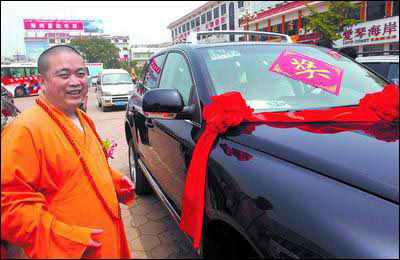
The Shaolin Temple, widely considered the birthplace of Chinese Kungfu, has frequently been in the spotlight following some headline-grabbing events, such as the super-girl-style Kungfu Competition, a luxury sports car awarded to the temple, and the latest Wushu festival, with Shi Yongxin, the abbot, at the core of it.
"Super Girl" [超女] is China's version of pop idol singing contests such as American Idol. In the Shaolin version, called "Star of Chinese Kung-Fu" [中國功夫之星], the competitors don't sing, but rather demonstrate their martial arts skills. The winner receives a contract to star in a television show about the Shaolin Temple.

A picture of the luxury sports car mentioned above accompanied this previous article at China Daily about the abbot:


Anyway, the article continues:
Shi was admitted to the Shaolin Temple in 1981, when the temple was in a stark recession with only a dozen monks living on 28 mu (about 1.86 hectares) of farmland. He began to act as abbot in 1987 at 22, five years after the internationally acclaimed martial arts movie 'Shaolin Temple', starring Hong Kong movie king Jet Li, which put Shaolin Kungfu as well as the temple in the international spotlight.
So, he was admitted to the temple at age 16, and 6 years later, he had become the abbot. He seems like quite the ambitious fellow!
Ever since his inauguration, Shi has stressed the importance of cultural exchange with foreign countries, and has carried out a series of reforms to expand the influence of the temple, securing international renown for the temple and making it a pillar of the tourism industry in Dengfeng where it is located.

In spite of his success in gaining unprecedented attention for the Shaolin Temple, people are questioning whether the temple remains a holy place of Zen Buddhism or has become a commercialized tourist site, and whether the abbot is hero for his reforms or a temple CEO stinking with money. [...]

When Shi took over the temple as abbot 20 years ago, it was a little-known ancient temple. Today, the temple has under its flag a special liaison office, a temple affairs office, a website, and two commercially-run companies, and the abbot is often hailed as the 'CEO' of Shaolin Temple. [...]
I would hardly call Shaolin "a little-known ancient temple". It was certainly well-known 20 years ago among people of East Asian cultural background, as well as martial arts aficionados. And long before Jet Li's movie "Shaolin Temple", it was made famous in the West by the television series starring David Carradine.
Back in 1993, Shi Yongxin took a ham manufacturer to court for promoting the ham under the brand "Shaolin," which he claimed constituted a trademark infringement. It was the first case on brand rights in China's religious circles. [...]
Hmmm... ham. (Homer-Simpson-drool.)
Many suspect such commercial aspirations will disturb the tranquility of the temple. Shi, however, believed such establishment is a result of the interplay between business and brand, likening Shaolin Temple to the American Disneyland, which is a brand as well as a business.
But should the Shaolin Temple be likened to Disneyland, rather than, for example, St. Peter's Basilica? In other words, is it primarily a tourist attraction, or a religious site?

南無阿彌陀佛

Sunday, October 8, 2006

Chinese border guards fire on Tibetan refugees escaping to Nepal

From AsiaNews:
Chinese guards stationed at the border between China and Nepal killed seven – not two as initially reported – people on 30 September when they opened fire on refugees fleeing to the mountains. A Buddhist nun and a child were among the victims.

Lama Tsering, a Buddhist monk from Kushinagar monastery in northern India, confirmed this to AsiaNews. He said: "In the monastery, we observed a day of prayer and fasting yesterday after it was confirmed that seven refugees were killed, including our sister and a child. According to initial reports, two people were killed but now we are certain that the death toll has risen."

The lama said: "The genocide by the Chinese Han soldiers against Tibetans is beyond description. They persecute us and have no scruples about killing us like flies just because of our Buddhist faith and deep reverence for the Dalai Lama."

The massacre was perpetrated when a group of about 70 refugees stumbled upon Chinese soldiers near Nangpa La pass, close to Mount Everest. As soon as the guards saw them, they opened fire and only 40 refugees managed to escape. [...]
The international community needs hold China accountable for its rampant abuses of human rights.

See also: 7名藏人中尼边境被中国边防人员打死 from The Epoch Times, and reports from BBC News and The Independent.

南無阿彌陀佛

Friday, October 6, 2006

China uses modern technology to protect Buddhist grottoes

From Xinhua comes a story about China's efforts to protect its archeological and cultural heritage, in this case the Kizil Buddhist Grottoes:
China will invest 17 million yuan (about 2.12 million U.S. dollars) to install an electronic monitor system in Kizil Thousand-Buddha Grottoes in northwest China's Xinjiang Uygur Autonomous Region.

The system, which will cover every grotto with infrared detectors and cameras to protect the relics, will start to be built at the end of this year, according to experts with a grotto research institution in Xinjiang.

The Kizil grottoes, one of China's most valuable ones with 10,000-square meters of frescoes and colorful sculptures, were first built in the third century. They depict life in the region where Buddhism thrived after the third century.

The frescoes of the Kizil Grottoes have been seriously damaged by nature and people during the 20th century.

In 1961, the grottoes were listed by the Chinese government as a cultural relic [and] put under the state protection.
Important Buddhist heritage sites in China have suffered an enormous amount of damage at the hands of humans over the centuries, having been the victims of thieves, looters, treasure hunters, Muslim iconoclasts, European adventurer-archeologists, Japanese imperialists, and most recently, Chinese Communists. The Cultural Revolution, which saw a spree of destruction of the symbols of Buddhism in China, was only 40 years ago. So it's heartening to see that the Chinese government seems to have realized the importance of protecting the cultural heritage, that belongs to all humanity, which lies within its borders.

南無阿彌陀佛

Thursday, October 5, 2006

Atrocious "Animal Olympics" in China

From UK's Daily Mail:
A black bear perches precariously on a scooter and is forced to drive a circus performer across a tightrope.

This shocking image is just the latest picture to emerge from the barbaric Animal Olympic Games in China, a country with a shameful animal rights record.

The event has provoked outrage and serious concerns among animal rights groups around the world including The Captive Animals' Protection Society.

Craig Redmond, UK-based campaigns manager, said: "The things these animals are being made to do are not natural acts, and there will no doubt be cruelty involved in making them perform these tricks."

Shirley Galligan from the Born Free foundation added: "This is degrading for the animals, insulting to our intelligence and a disaster for any possible chance of increasing respect for the wild animals we share the world with. The Shanghai Animal Olympics is about domination and manipulation."

Previous pictures from the 'games' have included kangaroos being forced to take part in boxing matches with their supposed keepers and a monkey cycling while tied by the collar to the children's bike.

Other events have included a sea lion high jump and a tug of war between an elephant and members of the audience, with more than 300 animals taking part.

[...]

The protests from animal rights groups has been felt by the Chinese Government, which is keen to improve its reputation among the international community in terms of both animal and human rights. This year's Olympics could therefore be the last.
The article links to a picture gallery and to other articles about animal abuse for entertainment in China. If decency and compassion don't move the Chinese government to outlaw these "games", or keep the Chinese people from patronising them, perhaps shame before the international community will cause them to reconsider.

南無阿彌陀佛

Sunday, October 1, 2006

Congressional Gold Medal for the Dalai Lama

From The Sydney Morning Herald:
President George W. Bush signed into law Wednesday a bill to present to the Dalai Lama a Congressional Gold Medal, the highest honour bestowed by the U.S. Congress.

The decision to honour the leader of Tibetan Buddhism, who is still widely revered in the mountainous region ruled by China, caused outrage in Beijing when the House of Representatives passed the measure two weeks ago.

At the time, Foreign Ministry spokesman Qin Gang denounced the decision, which he said "seriously interferes with China's internal affairs and damages China-U.S. relations." [...]

Other non-Americans who have been awarded the Congressional medal include Britain's World War II prime minister, Winston Churchill; Albanian-born humanitarian Mother Teresa; and Nelson Mandela, the first president of post-apartheid South Africa.
When the Dalai Lama is presented with the medal, he and Nelson Mandela will be the only two people who are both Congressional Gold Medal recipients and honourary Canadian citizens.

南無阿彌陀佛

Friday, September 8, 2006

The Leaning Tower of Yingxian

From Xinhua news comes a story about a leaning tower:
Sakyamuni Pagoda, believed to be the world's tallest wooden structure, celebrated its 950th anniversary on Tuesday amid concerns from architects that it is tilting. ...

There is an obvious tilt between the first and second floors and cracking of the interior wooden columns, and there are also 300 places in the pagoda that are in need of repair, said Chai Zejun, former director of the Shanxi Provincial Ancient Architecture Institute.

"The overall situation is dangerous and we are not optimistic. It is hard to tell whether the pagoda can survive more strong winds and earthquakes," said 82-year-old Luo Zhewen, head of the Experts Panel on Ancient Architecture with the State Bureau of Cultural Relics, who has visited the pagoda dozens of times since 1952.

Standing 67.31 meters tall, the octagonal pagoda in Yingxian County, Shanxi Province, is not only the tallest but the oldest existing wooden pagoda in China. The pagoda is 115 years older and 11.36 meters taller than the renowned Leaning Tower of Pisa in Italy.
But will it ever become as famous?

南無阿彌陀佛

The Dalai Lama visits Vancouver

The Dalai Lama, who is an honourary Canadian citizen, is currently visiting Vancouver:
The Dalai Lama made his fourth visit to Vancouver on Thursday to inaugurate the Dalai Lama Center for Peace and Education, the world's first learning facility established in his name.

The 71-year-old Nobel Peace Prize winner will also lead a series of public dialogues on the topics of peace, compassion and happiness -- the vision reflected in the non-religious, non-political institution.
The government of China is, of course, quite displeased:
"The Dalai Lama is not a religious leader. He's a political activist and also a secessionist," [senior Chinese embassy official Zhang Weidong] said.

"We hope that any country that is friendly to China should not provide him with a venue or podium for his political activities."

Besides his political stature among Tibetans which is causing problems with the government of China, the Dalai Lama is also embroiled in a number of controversies which complicates his status among Buddhists, something which usually doesn't come across in the often simplistic portrayals of the man presented in the media. However, most Buddhists respect the Dalai Lama as a spiritual leader, even if they disagree with him on certain political or philosophical issues.

南無阿彌陀佛

Saturday, August 26, 2006

Buddhism goes hi-tech in China

Buddhism is big business in China:
PIETY and a knowledge of Buddhist scriptures used to be just about the only qualifications needed to become a Chinese monk. Now computer skills, foreign language ability and a degree in financial management are also desirable.

Three decades after temples were destroyed and scriptures burned during the Cultural Revolution, Buddhism is making a comeback in China. And, like most things in the super-competitive, rapidly developing country, it has become both big business and a field in which people are eager to get ahead.

That's creating a new breed of multi-tasking, tech-savvy, upwardly mobile monks.

"Our recruiting process is highly competitive," said Hui Jue, the deputy general manager of the 120-year-old Jade Buddha Temple in central Shanghai, who recently completed a master of business administration degree at Jiaotong University.

Fifteen monks from his temple have been on foreign language courses at the Shanghai International Studies University, and another batch have started MBA studies in Jiaotong's business school.

Such skills are necessary, Mr Hui believes, for the temple to spread Buddhist teachings in the modern world and to manage its growing business interests. As well as its grounds, Jade Buddha owns a vegetarian restaurant, a four-star hotel, a seven-floor office building and a food factory.

The restaurant and the food factory I can understand, since the monks are vegetarian and have special dietary requirements, but why would they need a four-star hotel?

It goes without saying that one cannot mention Buddhism in China without referring to the famous Shaolin Temple:
The ancient Shaolin Temple in Henan province has capitalised on its reputation as a birthplace of the martial arts to host international guests and stage kung fu displays around the world.

It owns a martial arts training school and Shaolin Development, a company producing vegetarian snacks and Zen tea. It also co-operates with entertainment companies in film-making and online game production.

Guangxiao Temple in Guangdong province has launched online worshipping, so users can offer virtual incense, fruit and flowers to electronic Buddhas.


This picture, which accompanied the article, shows what appears to be a common computer desk as one might find in any workplace. What's unusual is that the picture is taken in Shaolin Temple, and person sitting at the desk is a monk, who is just about to go online:

A monk at China's Shaolin Temple, which helps produce computer games, logs on to the internet.

Picture: Cancan Chu/Getty Images

南無阿彌陀佛