Showing posts with label Shaolin temple. Show all posts

Saturday, November 18, 2006

Shaolin Football

There was a movie from Hong Kong a few years ago that was quite popular called Shaolin Soccer (IMDB entry). The movie starred Hong Kong comedy legend Stephen Chow [周星馳] as a down-on-his-luck disciple of Shaolin kung fu [少林功夫] who popularises the martial art by combining it with soccer.

In a case of life-imitates-art, Venerable Shi Yongxin [釋永信], the abbot of Shaolin temple [少林寺] (whom we have previously met in this post), plans to develop a football program there. But by "football" I am referring to American football here, not to what is called "soccer" by Americans.

From Buddhism-Online:
In the days following his first experience with American football, Abbot Shi Yongxin, leader of the Shaolin Temple in China, is developing plans to start a football program at the Temple.

In an effort to promote cultural exchange, the Abbot's goal is to develop a series of football teams that would tour the United States and play exhibition games. The names of the teams would mirror current American football teams.

[...]
Thank the gods that the high school team in Pekin, Illinois, long ago changed their name to the Pekin Dragons.
As part of the plan, the [United States Sports Academy] would provide football coaches and administrators to train athletes and build a program at the Shaolin Temple. For over 30 years, the Academy has delivered sports programs in more than 60 countries around the world. [...]

A 10-part certification program to teach Kung Fu and other martial arts is also being developed as a joint effort between the Academy and the Abbot.

The United States Sports Academy is an independent, non-profit, accredited, special mission sports university created to serve the nation and the world with programs in instruction, research and service. The role of the Academy is to prepare men and women for careers in the profession of sports.
In traditional Chinese Buddhism, kung fu is not considered a sport, but is one component of an integrated program of mental, spiritual, and physical training, the aspects of which are inseparable from one another. Of course, the physical training had long ago been separated from the rest, resulting in many schools of martial arts most of which have nothing to do with spirituality. But one would hope that the Shaolin temple of all places would try to maintain the traditional stance.

南無阿彌陀佛

Saturday, October 21, 2006

Shaolin Temple to become Buddhist Disneyland

I wrote about the commercialization of Buddhism in China in this previous post.

One of the central characters in this drama is the Venerable Shi Yongxin [釋永信], the charismatic abbot of the Shaolin Temple [少林寺]. From China Daily (via The Buddhist Channel):
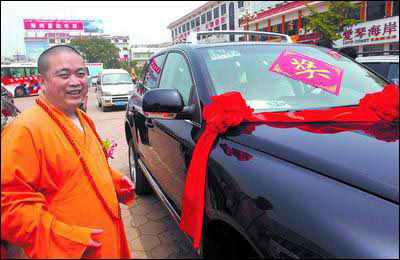
The Shaolin Temple, widely considered the birthplace of Chinese Kungfu, has frequently been in the spotlight following some headline-grabbing events, such as the super-girl-style Kungfu Competition, a luxury sports car awarded to the temple, and the latest Wushu festival, with Shi Yongxin, the abbot, at the core of it.
"Super Girl" [超女] is China's version of pop idol singing contests such as American Idol. In the Shaolin version, called "Star of Chinese Kung-Fu" [中國功夫之星], the competitors don't sing, but rather demonstrate their martial arts skills. The winner receives a contract to star in a television show about the Shaolin Temple.

A picture of the luxury sports car mentioned above accompanied this previous article at China Daily about the abbot:


Anyway, the article continues:
Shi was admitted to the Shaolin Temple in 1981, when the temple was in a stark recession with only a dozen monks living on 28 mu (about 1.86 hectares) of farmland. He began to act as abbot in 1987 at 22, five years after the internationally acclaimed martial arts movie 'Shaolin Temple', starring Hong Kong movie king Jet Li, which put Shaolin Kungfu as well as the temple in the international spotlight.
So, he was admitted to the temple at age 16, and 6 years later, he had become the abbot. He seems like quite the ambitious fellow!
Ever since his inauguration, Shi has stressed the importance of cultural exchange with foreign countries, and has carried out a series of reforms to expand the influence of the temple, securing international renown for the temple and making it a pillar of the tourism industry in Dengfeng where it is located.

In spite of his success in gaining unprecedented attention for the Shaolin Temple, people are questioning whether the temple remains a holy place of Zen Buddhism or has become a commercialized tourist site, and whether the abbot is hero for his reforms or a temple CEO stinking with money. [...]

When Shi took over the temple as abbot 20 years ago, it was a little-known ancient temple. Today, the temple has under its flag a special liaison office, a temple affairs office, a website, and two commercially-run companies, and the abbot is often hailed as the 'CEO' of Shaolin Temple. [...]
I would hardly call Shaolin "a little-known ancient temple". It was certainly well-known 20 years ago among people of East Asian cultural background, as well as martial arts aficionados. And long before Jet Li's movie "Shaolin Temple", it was made famous in the West by the television series starring David Carradine.
Back in 1993, Shi Yongxin took a ham manufacturer to court for promoting the ham under the brand "Shaolin," which he claimed constituted a trademark infringement. It was the first case on brand rights in China's religious circles. [...]
Hmmm... ham. (Homer-Simpson-drool.)
Many suspect such commercial aspirations will disturb the tranquility of the temple. Shi, however, believed such establishment is a result of the interplay between business and brand, likening Shaolin Temple to the American Disneyland, which is a brand as well as a business.
But should the Shaolin Temple be likened to Disneyland, rather than, for example, St. Peter's Basilica? In other words, is it primarily a tourist attraction, or a religious site?

南無阿彌陀佛

Saturday, August 26, 2006

Buddhism goes hi-tech in China

Buddhism is big business in China:
PIETY and a knowledge of Buddhist scriptures used to be just about the only qualifications needed to become a Chinese monk. Now computer skills, foreign language ability and a degree in financial management are also desirable.

Three decades after temples were destroyed and scriptures burned during the Cultural Revolution, Buddhism is making a comeback in China. And, like most things in the super-competitive, rapidly developing country, it has become both big business and a field in which people are eager to get ahead.

That's creating a new breed of multi-tasking, tech-savvy, upwardly mobile monks.

"Our recruiting process is highly competitive," said Hui Jue, the deputy general manager of the 120-year-old Jade Buddha Temple in central Shanghai, who recently completed a master of business administration degree at Jiaotong University.

Fifteen monks from his temple have been on foreign language courses at the Shanghai International Studies University, and another batch have started MBA studies in Jiaotong's business school.

Such skills are necessary, Mr Hui believes, for the temple to spread Buddhist teachings in the modern world and to manage its growing business interests. As well as its grounds, Jade Buddha owns a vegetarian restaurant, a four-star hotel, a seven-floor office building and a food factory.

The restaurant and the food factory I can understand, since the monks are vegetarian and have special dietary requirements, but why would they need a four-star hotel?

It goes without saying that one cannot mention Buddhism in China without referring to the famous Shaolin Temple:
The ancient Shaolin Temple in Henan province has capitalised on its reputation as a birthplace of the martial arts to host international guests and stage kung fu displays around the world.

It owns a martial arts training school and Shaolin Development, a company producing vegetarian snacks and Zen tea. It also co-operates with entertainment companies in film-making and online game production.

Guangxiao Temple in Guangdong province has launched online worshipping, so users can offer virtual incense, fruit and flowers to electronic Buddhas.


This picture, which accompanied the article, shows what appears to be a common computer desk as one might find in any workplace. What's unusual is that the picture is taken in Shaolin Temple, and person sitting at the desk is a monk, who is just about to go online:

A monk at China's Shaolin Temple, which helps produce computer games, logs on to the internet.

Picture: Cancan Chu/Getty Images

南無阿彌陀佛