Showing posts with label Religious fanaticism. Show all posts

Saturday, December 30, 2006

Fire of hatred continues to burn in southern Thailand

In this previous post, I wrote about how Islamist insurgents in southern Thailand are targeting civilians and using fire as a weapon. It's now more than a month later, and the fire of hatred continues to burn. From the International Herald Tribune:
Two teachers were shot and burned to death in Thailand's restive south Friday by suspected Muslim insurgents, while a government worker and a grocery store owner were killed in other attacks, police said.

[...]

Despite offers of peace and reconciliation by the country's military-backed government, violence has increased in recent months.
Just as Christians worldwide aren't paying enough attention to what's happening to their co-religionists in the Middle East (see this previous post), Buddhists worldwide haven't been paying enough attention to the changing nature of the interaction between Muslims and Buddhists, and between Islam and Buddhism, in Southeast Asia (see these previous posts).


Update: The following article from The Nation refrains from naming the religion of the victims or that of the killers and bystanders, despite explicitly alluding to religious differences:
The wife of a teacher who was shot dead and set on fire by suspected militants has accused local villagers of doing nothing while her husband and his colleague were set ablaze.

On Friday, suspected militants shot dead Chamnong Chupatpong, the director of the Ban Bado elementary school, and a teacher, Manoe Sonkaew, and set their bodies on fire on a road just 100 metres away from the village school at which they worked in Yala's Tambon Yupo.

Kawin Chupatpong said the attack on her husband and his colleague had taken place in front of the villagers, who remained inside their homes instead of coming out to help the two victims.

"My husband has been helping them and educating their children for the past decade, and the differences in our religious beliefs was never an obstacle. But this shows that our good deeds were not reciprocated," Kawin said.

"My father and his school helped raised money for the construction of the local mosque, so the children could have a place to pray. He even used his own money," said the couple's daughter Monthida, a senior at Kasetsart University.
The context makes it clear that the victims were Buddhists while the villagers were primarily Muslim. While I understand the family's anguish, the villagers were probably too terrified for their own lives to do anything to prevent the murders.
Police Maj-General Phaitoon Choochaiya, commander of the Yala Provincial Police, told reporters yesterday that the absence of eyewitnesses has made his work much more difficult.

He said the brutal attack had sent a chilling message to the entire community, and hence the refusal of the villagers to come forward with information. [...]

Authorities said a new generation of militants have effectively shattered the fabric of the local community by singling out monks and teachers, along with security officials and their informants. [...]
This sentence is written in code: "monks and teachers" means "Buddhists", "informants" means "Muslims" (i.e., those who are sympathetic to Buddhists), and "shattered the fabric of the local community" means "driven a wedge of distrust and fear between them". And that is precisely the goal of the terrorists.

南無阿彌陀佛

Friday, December 29, 2006

Christians disappearing from Bethlehem and the Middle East

The town of Bethlehem [בית לחם], the birthplace of Jesus according to Christian tradition, is emptying of its Christian population. From the Daily Mail:
It is one of the most sacred sites in Christendom, but there are no tourists queuing to see it.

Just 500 yards down the road, Joseph Canawati is not looking forward to Christmas.

The expansive lobby of his 77-room Hotel Alexander is empty and he says: "There is no hope for the future of the Christian community.

"We don't think things are going to get better. For us, it is finished."

Life for Palestinian Christians such as 50-year-old Joseph has become increasingly difficult in Bethlehem — and many of them are leaving.

The town's Christian population has dwindled from more than 85 per cent in 1948 to 12 per cent of its 60,000 inhabitants in 2006.

There are reports of religious persecution, in the form of murders, beatings and land grabs. [...]

The sense of a creeping Islamic fundamentalism is all around in Bethlehem.

A mosque on one side of Manger Square stands directly opposite the Greek Orthodox and Roman Catholic churches, while in the evening the muezzin's call to prayer clashes with the peal of church bells. [...]

This isolation was heightened when, last year, Bethlehem found itself behind Israel's security wall, a 400-mile-long concrete barrier which separates Jewish and Palestinian areas and is designed to stop suicide bombers - in 2004, half the Israeli fatalities caused by such attacks were committed by extremists from Bethlehem. [...]
The terrorists obviously chose the town of Bethlehem as a staging ground for strategic as well as symbolic reasons. If Israel had build its security wall to include Bethlehem, it would have left itself vulnerable to attack. By excluding Bethlehem, however, Israel is effectively strangling one of the holy places of Christianity and thus earning the ire of Christians. Either way, the terrorists win.

Here are two articles about Christian disapproval of the Israeli wall due to its isolation of Bethlehem:The following article from Times Online begins by placing the blame for the flight of Christians from the Middle East squarely on the shoulders of the West:
Christians in the Middle East have paid a high price for the Iraq war, the publication of cartoons depicting the Prophet Muhammad and the Pope’s controversial remarks about Islam.

Egyptian Copts, Iraqi Chaldeans and the Palestinian Orthodox, Roman Catholic and Protestant communities have faced violence and even death at the hands of their Muslim neighbours. [...]
The problem with this theory is that Middle Eastern Christians have been persecuted by and "faced violence and even death at the hands of" their Muslim neighbours long before the relatively recent events mentioned above. The article is accompanied by the following graphic and even notes that the flight of Christians from the Middle East started more than a century ago:

Christians in Jordan and other neighboring states began leaving for the West more than a century ago to escape the poverty of the Ottoman Empire. Estimates put the number of Arab Christians living in the diaspora at 4 million, with between 10 million and 15 million living in the Middle East.
It is a pity that the West, which is ostensibly Christian, does not pay more attention to the plight of Christians in the Middle East.

南無阿彌陀佛

Saturday, November 25, 2006

The fire of hatred

Update: Flopping Aces questions the authenticity of reports of burnings from Iraq, noting that they might contain fabrications or exaggerations by those wishing to exacerbate the situation there. See also The Lede (a New York Times blog).


Fire is one of the most destructive and fearsome processes in nature. In Buddhist teachings, fire is often used as a metaphor for anger and hatred, due to its ability to spread quickly and burn out of control, leaving a trail of devastation in its wake.

Two horrific stories today illustrate the close relationship between fire and hatred.

In Thailand, the Islamist terrorists continue to target civilians. From The Nation:
Nont Chaisuwan, 51, the director of Bang Kao School in Pattani, was shot while driving home after school. His car crashed into the roadside after the attack. The gunmen then set fire to the car and burned him alive, police said.

Four men and a woman were injured in a bomb blast at a grocery shop in Yala's Yaha district at 2pm. Police said the bomb was hidden under a stall in front of the shop, which is at the mouth of a lane leading to the Yaha Pracharam Buddhist temple.

Shop owner Apinan Yothinkamchornchai was severely injured, along with his customers.

Insurgents burned down a Provincial Electricity Authority office in Yala, causing a Bt15-million loss.

Security guard Manwan Ismail said at least 10 hooded insurgents wearing black arrived at the authority's office in Bannang Sata district at around 3am.

One forced him to crouch at gunpoint. The others destroyed the closed-circuit-camera control room and then other rooms before setting fire to the building. They also used burning motorcycle tyres to set fire to five cranes and trucks.

Police suspect the attackers were the same group that burned down the district's Land Office on Monday. Their faces were captured by closed-circuit cameras during that attack.

In Narathiwat, a building at Ban Bo Thong School in Rangae district was set on fire just after 1am.

School director Banyat Tannu said the 10-year-old building with five classrooms was for 261 students in kindergarten and first and second grades. It also had a prayer room. He said he would find tents to use as classrooms.

The arson attack occurred despite the best efforts of the village chief and defence volunteers to protect the school, which made people feel discouraged, he said.
Meanwhile, in Iraq, the cycle of revenge continues. From The Sydney Morning Herald:
Revenge-seeking militiamen seized six Sunnis as they left prayers and burned them alive with kerosene in a savage new twist to the brutality shaking Baghdad today.

The attack in the Iraqi capital came a day after suspected Sunni insurgents killed more than 200 people in Baghdad's main Shi'ite district.

Iraqi soldiers at a nearby army post failed to intervene in yesterday's assault by suspected members of the Shi'ite Mehdi Army militia or subsequent attacks that killed at least 19 other Sunnis, including women and children, in the same area, the volatile Hurriyah district in north-west Baghdad, said police Captain Jamil Hussein.

Most of the thousands of dead bodies that have been found dumped across Baghdad and other cities in central Iraq in recent months have been of victims who were tortured and then shot to death, according to police. The suspected militia killers often have used electric drills on their captives' bodies before killing them. The bodies are frequently decapitated.

But burning victims alive introduced a new method of brutality that was likely to be reciprocated by the other sect as the Shi'ites and Sunnis continue killing one another in unprecedented numbers.

The gruesome attack, which came despite a curfew in Baghdad, capped a day in which at least 87 people were killed or found dead in sectarian violence throughout Iraq.

In Hurriyah, the rampaging militiamen also burned and blew up four mosques and torched several homes in the district, Hussein said. [...]

But Imad al-Hasimi, a Sunni elder in Hurriyah, confirmed Hussein's account of the immolations. He told Al-Arabiya television he saw people who were drenched in kerosene and then set afire, burning to death before his eyes.

The Association of Muslim Scholars, the most influential Sunni organisation in Iraq, said even more victims were burned to death in attacks on the four mosques. It claimed a total of 18 people had died in an inferno at the al-Muhaimin mosque. [...]
The insurgents in Thailand and Iraq are in fact contravening an injunction by the prophet of Islam forbidding the use of fire to burn one's enemies. From the hadith collection of Bukhari, Volume 9, Book 84, Number 57:
Narrated 'Ikrima:

Some Zanadiqa (atheists) were brought to 'Ali and he burnt them. The news of this event, reached Ibn 'Abbas who said, "If I had been in his place, I would not have burnt them, as Allah's Apostle forbade it, saying, 'Do not punish anybody with Allah's punishment (fire).' I would have killed them according to the statement of Allah's Apostle, 'Whoever changed his Islamic religion, then kill him.'"
See also Bukhari, Volume 4, Book 52, Number 260.

The insurgents claim that they are fighting for Islam. The least they can do is to refrain from violating the dictates of the religion. (That they murder apostates is abhorrent — but it is not also hypocritical.) But they are so consumed by hatred that they likely won't care about such technicalities.

The Buddha taught that there is only one way to overcome hatred. From the Dhammapada [法句經], Chapter 1, verse 5:
Hatred is never appeased by hatred in this world. By non-hatred alone is hatred appeased. This is an eternal law.

在這世上,恨絕不能止恨,唯有慈愛方能止恨,這是永恆的真理。
When someone has wronged you, it is extremely difficult to maintain a feeling of loving-kindness [Pali mettâ; Sanskrit maitrî मैत्री; Chinese 慈] towards that person. And yet, this is a lesson that the terrorists must sooner or later learn. Their current habit of acting out in violence not only causes injury and death all about them, but will ultimately visit destruction and ruin upon themselves.

南無阿彌陀佛

Sunday, November 19, 2006

Wishful thinking blinds us to dangers of religious fanaticism

As the situation in Thailand deteriorates (see this post and this post), Buddhists are waking up to the reality and dangers posed by fanatics who wish to impose Islamic rule upon them. But in spite of the situation, many Buddhist leaders, such as the Dalai Lama, continue to insist that Islam is a peaceful religion that has been misappropriated by extremists.

I have already commented in this post on one major reason why it is difficult for some Buddhists to conceive of Islam as a religion that is based on very different values and assumptions about the world than Buddhism, and I want to elaborate on that here.

Up until only a generation or two ago, the Islam practised by most Muslims in East and South East Asia had been heavily syncretic, blending elements of Hinduism, Buddhism, Confucianism, animism, spiritism, and various indigenous religions with a gentle and mystical interpretation of Islamic beliefs. It was only relatively recently, with the return of a generation of young Muslims educated abroad primarily in the Middle East, and the introduction of Islamic schools funded by Muslim organisations from the heartland of the Muslim world, that East and South Easth Asian Islam has taken a more literalist, exclusivist, and puritan turn. From the perspective of the Buddhists who had been living alongside liberal Muslims for generations, it is the syncretic local Islam that is the "true Islam", and the puritanism introduced from elsewhere that is the abberation.

An article which appeared two years ago in the Asia Times (November 2, 2004) described the situation in southern Thailand as follows:
Ethnic-Malay and Thai Muslims traditionally practice Sufism – Sunni Islam with a mystical, moderate edge – which has prevailed in Indonesia, Malaysia and Thailand since Islam supplanted animism, Buddhism and Hinduism a few hundred years ago.

"There is the traditional kind of Muslim beliefs common in the region and there are the newer beliefs, reformist ideas brought back by those who studied in the Middle East," says Michiko Tsuneda, a University of Wisconsin cultural anthropologist studying Thai-Malay Muslim communities in southern Thailand.
Note that here it is the hardliners who are referred to as the "reformists", while the liberals are the "traditionalists" — which is the reverse of the situation found in Middle Eastern countries such as Saudi Arabia and Iran.
That fundamentalism should appear is not surprising. It is strikingly visible in the men's dress, which is more Afghan or Middle Eastern than Malay, and the face-covering chadors worn by women. Increasingly they can be seen in Tak, Chiang Rai and other parts of the country, not just the south.

[...]
This is yet another example of Islamic imperialism — the replacement of a non-Arab people's culture and history by an Arab-Islamic construction.
Fundamentalism's rise in the Middle East took off early in the 20th century, if not before, but only really started to reach the Malay Peninsula in the 1970s, as cheaper travel allowed more Southeast Asian Muslims to seek higher education in the Middle East. "Usually Islamic schoolteachers, if they've had higher education, they usually studied in the Middle East," says Tsuneda. Some returned preaching fundamentalism. A few became followers while fighting the Soviets in Afghanistan.

[...]

"If you hear people talking about these things, they are emotional. From the perspective of the traditionalists, what they have believed all their lives is being attacked. The villagers, the traditionalists, don't really have the social capital to back their point of view. The reformists have higher education, they have been to the Middle East, they can claim they know better than the traditionalists, leaving the villagers in a difficult situation," says Tsuneda.

[...]
And this is precisely the problem. In addition to oil wealth, Middle Eastern Muslim nations can also boast of places of religious significance and historical importance to Islam. The Thai Muslim traditionalists simply do not have the resources to compete with them.

From WorldWide Religious News (April 14, 2004):
Each year, 300 Thai Muslims win scholarships from institutions in Saudi Arabia, Egypt, Jordan and other Middle Eastern countries, while another 200 are funded in other Muslim countries, including Brunei, Sudan and Indonesia.

Some families have sent abroad generations of sons who become imams at mosques and directors or teachers at pondoks. These teachers place more emphasis on study of Arabic and the Quran.
The traditionalists for the most part do not use Arabic except for a few formulaic phrases, and place more emphasis on the Qur'an's role as a talisman than as a book to be studied.
The Middle Eastern influences also have spilled over into everyday life.

Islamic practices in southern Thailand used to be mixed with local traditions. These customs are now being branded un-Islamic by clerics.

Until a few years ago, women rarely wore headscarves. But the foreign-returned Muslims are insisting on purer form of Islam such as "hijab" for women and regular attendance at mosques.
The Bangkok Post ran an article earlier this year (no longer online; mirrored at The Buddhist Channel, August 28, 2006) about the decades-long friendship between Ven. Buddhadasa, a renowned Thai Buddhist monk, and a Thai Muslim named Prayoon Vadanyakul. I think it serves very well to illustrate the kind of Islam that was traditionally practised in Thailand and how South East Asian Muslims have historically understood Islam in the context of Buddhism and other religions.
Bangkok, Thailand -- The roar of bombs. The macabre, pervasive scent of death. In the deep South and across the whole globe, strife in the name of religion is steadily growing.

But there was one remarkable friendship that cut across religious boundaries: The friendship between Buddhadasa Bhikkhu and a devout Muslim named Haji Prayoon Vadanyakul.
The title "Haji" denotes a Muslim who has made the pilgrimage to Mecca, the Hajj [حج].
Born to a Muslim family, Haji Prayoon was well-known among his close associates for his seriousness in practising his religion. But his interests were not restricted to Islam. He was sent to a Christian school, and later made friends with several Buddhists. One day he decided to travel to the Suan Mokkh forest monastery to pay a visit to Buddhadasa Bhikkhu. [...]
Note how Haji Prayoon Vadanyakul syncretises Islam and Buddhism in the following passages:
The first meeting between Haji Prayoon and Buddhadasa lasted eight hours.

"The way Than Acharn [Buddhadasa] discussed Buddhism, it sounded as if he was guiding me toward the goal of Islam as well.

"Truth exists in both [religions], but lacking are those who can show that they are one and the same. Most people keep their guard up during [inter-religious] dialogue. That's not true education. They try to discredit others; that's not the path toward mutual understanding."

On that very day, it could be said Haji Prayoon found a guide to lead him toward the same truth. Religious differences did not pose a barrier, but instead served to help him attain the essence of his own faith.

"The kind of Buddhism I learned about was mundane, at the ethical level. Nothing special about it. But having met Than Acharn, read his books and contemplated them, I came to understand the ultimate truth.

"From that day on, I continued to study his books, comparing them to the Koran, and I became more and more enlightened. I didn't come to pay respects to him that often. I only came once in a long while. But there was this deep tie. Every time I visited him, it was like I came to report to him about my spiritual progress. This mutual understanding kept me growing steadily.

"I try to avoid saying that Buddhadasa's views are the right ones. Otherwise some others [schools of thought] might charge me with being presumptuous. They might say, 'How do you know that your teacher is correct?' I'd rather say that his views are sensible and sound. Other people may not agree with me. But his views of Buddhism helped me to understand Islam correctly.

"Being registered as a Muslim, I'm able to expound on the teachings of Islam. But if I didn't grasp the essence of Buddhism through Buddhadasa, I might not be able to grasp the essence of Islam as well. I would have still memorised the teachings that have been passed on by tradition, without discovering any real solution.
It's interesting that he described himself using the words "registered as a Muslim", rather than saying more straightforwardly that he was a Muslim. (In neighbouring Malaysia, a person's religion is printed on his national identity card.)
"The Muslims like to lull their child to sleep by a short phrase - 'La illaha ill-Allah' - the declaration of truth made during prayer. They will keep reciting 'La illaha ill-Allah' on beads - until they achieve a state of mental concentration. Unfortunately, most people do not understand the core meaning; they usually translate it as 'There is no god but Allah.'
And that's because that is the actual meaning of the phrase, in Arabic.

Note the folk practice of using the Islamic profession of faith (the shahâdah [شهادة]) as a lullaby, and the very Buddhist idea that the purpose of the recitation is to "achieve a state of mental concentration".

Haji Prayoon Vadanyakul continues:
"The word 'Allah' consists of three letters: A, L and H. The word 'Araha[t]' consists of the letters: A, R and H. Typically, the L in the West has been transformed to R in the East. Thus 'elephant' becomes 'Erawan'. So does 'Ali' [the Noble] become 'Ariya' as in Ariyasaj [The Noble Truth].
This is just bad linguistics, and would be easily and decisively refuted by someone who had gone abroad to study Arabic.
"I used to discuss these linguistic issues [with others]. Here I repeat it for those who haven't heard about this principle. Allah is in fact Arahat. The meaning of Allah is broader than Illaha, which means 'idols', and La, which means 'no', or 'do not'. Most of the Muslims take Illaha to mean things like sculptures, trees and so on. But I think [the word] refers to the clinging to that very object in their heart. Those statues and trees are in themselves nothing sacred.

"But when people hold on to such things, they become objects of worship. If people do not hold on to them, they cannot be sacred. These things don't have their own power; it's the people who give them power. Therefore, illaha does not refer to those external objects, but to the clinging in human heart. So the sentence La illaha ill-Allah means not to hold on to anything. Such is the state of Allah, or Arahat. How that is literally identical to the heart of Buddhism that professes against any attachment! How couldn't I say then that the heart of Buddhism is one and the same as that of Islam?" [...]
Even if we accept that the Arabic word 'ilah [إله] means an object to which one clings, the formula would still mean "do not hold on to anything except Allah", where, following his interpretation, Allah would mean The One Thing to which one clings.

Haji Prayoon Vadanyakul also leaves out the second half of the shahâdah, which declares that Muhammad is the messenger of Allah. I don't see how this can be reconciled with his interpretation of the word 'ilah.
"Than Acharn wants every religion to unite to bring peace to the world. He once told me, 'Khun Prayoon, let's work together to merge religions.' I told him that, on the level of customs and traditions, it might not be possible. For example, at the time of death, some groups want to bury [the body], other groups want to burn [the body]. But at the level of truth, even though we don't merge, they are already one and the same. It is the individual religious teachers who can't arrive at the truth. It is not the case that religions can't reconcile, if we take their purpose as the goal, be it on the mundane or supra-mundane level."

Haji Prayoon was a driving force in propagating Buddhadasa's ideas of inter-religious understanding - through his writing, talks, and donations - to the point that some of his cohorts charged him of being haek khok (literally, "breaking out of the cage; rebellious").

[...]
In the current climate, his coreligionists would undoubtedly have charged him with heresy or apostasy.
"This understanding is not limited to the thing called religion, be it Buddhism, Christianity, Islam, Brahmanism, Sikh and so on. It's about understanding dharma that has no other name besides dharma.
Not even the Arabic word deen [دین]?
"The enemy of religion is the absence of dharma. Religions cannot be like men rowing different boats, trying to compete against each other. They must be rowing the same boat and helping each other. We need cooperation to save the world. We have to chip in, not fight and quarrel against one another. But whichever religion one wants to follow depends on one's individual preferences.

"Every time I take part in helping any religion, I just hold to one principle: To spread the rightful dharma among the people, for it's what the world urgently needs - that's all.

"When a monk comes to take up abode in the compound of my house where there are a lot of trees, I only have one request: When asked for some auspicious objects, please give the people Lord Buddha's dharma and not something superstitious like an amulet. Otherwise I have to ask him to leave. Buddhism must be preserved, even in a Muslim house. And we have to do it seriously to shore up Buddhism. [...]
Sadly, with the introduction of more literalist and puritan strains of Islam from the Middle East, the syncretic and liberal Islam of Muslims such as Haji Prayoon Vadanyakul might become a thing of the past. And this trend towards rejecting local traditions in favour of Arab-Islamic imperialism isn't happening only in Thailand, but all across the Muslim world, under the influence of petrodollars.

Many Buddhists continue to believe that Islam is a peaceful, compassionate religion that is being misused by extremists for political ends, because the Muslims that they know are peaceful, compassionate people. But just as Islam should not be judged solely by the actions of some terrorists, it likewise should not be judged solely by the behaviour of some Muslims who practise a syncretic form of the religion. Islam, like any other religion, must be judged based on its own merits and demerits: its teachings, its core texts and how they are interpreted in practice, its history, and so on.

The first component of the Buddha's Eightfold Path (八正道) is Right View (正見). Before anything else, a practitioner of Buddhism must strive to see the world as it is, and not be clouded by wishful thinking such as the desire to think the best of every religion or the assumption that all religions teach the same things.

南無阿彌陀佛

Saturday, November 18, 2006

Human Rights Watch tells terrorists in southern Thailand to stop targeting civilians

Human Rights Watch has condemned the actions of the Islamist terrorists in Thailand. From Human Rights News:
Separatist insurgent groups in southern Thailand must stop targeting civilians in their effort to establish an independent state, Human Rights Watch said today. In the past week alone, insurgents have killed and injured more than 30 civilians in targeted attacks in the country’s southern provinces.
What makes Human Rights Watch think that the terrorists will care about what they have to say?
“Insurgent groups are targeting civilians to show their power and highlight the Thai government’s weakness,” said Brad Adams, director of the Asia division at Human Rights Watch. “But it’s illegal, and morally indefensible, to attack civilians in pursuit of political goals.”

[...]
I doubt that the terrorists are concerned with either the legality or morality of their actions. The problem is that they believe they have God on their side.
Human Rights Watch expressed deep concern about the enormous and growing numbers of attacks by insurgent groups on civilians since the renewal of violence in southern Thailand in January 2004.

According to a study released by the Thai Journalist Association and Prince of Songkhla University, insurgent groups are responsible for most of the 5,460 violent incidents in the southern border provinces of Thailand between January 2004 and August 2006 which resulted in 1,730 deaths and 2,513 injuries. Civilians – including government employees and local officials – have been the principal targets of daily attacks, totaling 60 percent (or 1,873) of the victims, followed by police (16 percent, or 481), soldiers (12 percent, or 373), and others (12 percent, or 369).
The statistics would have been more useful if they had separated out "government employees and local officials" from regular "civilians". But in any case, many more civilians are affected than are counted by the study, since they have been fleeing to escape the violence and threats of violence.
The study found that the majority of victims were Muslims; 924 Muslims were killed and 718 injured, compared with 697 Buddhists killed and 1,474 injured. The religion of the remaining victims is unknown.

“The insurgents claim to be defenders of the Muslim population against abuses and exploitation at the hands of the mainly Buddhist Thai authorities,” said Adams. “But hundreds of Muslims as well as Buddhists have died in their attacks.”
I appreciate that Human Rights Watch wishes to point out the hypocrisy of terrorists who murder Muslims while claiming to be protecting Muslims. But the numbers don't support the claim that "the majority of victims were Muslims" — they show 1642 Muslims and 2171 Buddhists among the casualties whose religions are known.

It is true that more Muslims have been killed than Buddhists, and that could be because the terrorists are more precise when they target Muslims, i.e., they specifically murder those whom they consider to be traitors.
Common insurgent tactics include drive-by shootings from motorcycles or pickup trucks and the use of improvised explosive devices (IEDs). The use of such devices, apparently emulating tactics used by insurgents in Iraq, has increased the intensity and lethality of attacks on civilians since June 2006. Human Rights Watch has documented disturbing evidence that insurgent groups have engaged in beheadings and in mutilation of corpses as a form of punishment of Buddhist and Muslim civilians suspected of being informants, or of collaborating with Thai authorities.

At least 17 victims have been beheaded, and more than 40 Buddhists and Muslims have been hacked to death with machetes, over the past two years.
I noted the religious significance of beheadings in this previous post on the situation in southern Thailand.
There have been hundreds of insurgent attacks on teachers and schools since January 2004. Some districts have shut down all government schools due to security concerns after attacks. Buddhist monks in Narathiwat decided to stop taking alms after a bomb ripped through a column of monks, along with the soldiers guarding them, on October 22. That was the latest in a series of attacks on Buddhist monks — including shootings, bombings and hacking with machetes. On November 8, the entire Buddhist population from three villages in Yala’s Than To and Bannang Sata districts fled their homes and sought refuge at a Buddhist temple after armed insurgents killed Boon Iamsa-ard, 68, and his daughter Aree Iamnirand, 28, and then burned down their house.

Since the new spate of violence began in 2004, insurgent attacks have become increasingly coordinated and targeted against civilians. On September 16 insurgents targeted department stores and related locations in Hat Yai district of Songkhla province, killing four civilians and injuring 59. Another series of coordinated explosions took place on August 31, targeting commercial banks in Yala. On June 15 and 16, insurgent groups launched a series of bombs attacks in 31 of 33 districts in the southern border provinces.

“Increasingly, insurgent violence is being used to scare away Buddhists and keep Muslims under control,” said Adams. [...]

Human Rights Watch called on the Thai government and insurgent groups to institute concrete measures to protect civilians and immediately cease all attacks that do not discriminate between combatants and civilians. In addition, Thai authorities and insurgent groups should permit independent, impartial and effective investigations of allegations of human rights abuses, and ensure that those found responsible be held accountable.

“Neither side in the conflict in Thailand’s southern border provinces pays enough attention to human rights issues,” said Adams. “The failure to address human rights concerns adds to the growing hostility, making peaceful conflict resolution through dialogue an impossible goal.”
Does Human Rights Watch really believe that the terrorists will "permit independent, impartial and effective investigations of allegations of human rights abuses, and ensure that those found responsible be held accountable"?

I don't understand why human rights organisations always act as though they were under the obligation to treat every side in every conflict as if they were all equally morally culpable. The Thai government has on occasion acted in a heavy-handed and callous manner that did not distinguish between insurgents and civilians, but the insurgents have been deliberately targeting civilians. Surely, there is a world of difference between callousness and premeditation?

The violence has actually gotten worse since a coup in September put a more conciliatory government into power. From Yahoo News:
Since September, the month of [former Thailand prime minister] Thaksin's removal, Dougherty [of Bangkok-based security consultants Hill and Associates] said the daily violence was claiming almost three times as many civilians victims as before, a clear indication of a shift in tactics.

In one week alone, 90 percent of casualties were civilian, the remaining 10 percent being described as "officials" — anything from soldiers and border police to village volunteers and local government bureaucrats.
And where are all the voices who condemn Israel every time a Palestinian civilian is killed, even if the death resulted from terrorists using civilians for cover?

南無阿彌陀佛

Glenn Beck presents "Exposed: The Extremist Agenda"

I saw this program on CNN Headline News a few days ago:


There's nothing surprising in this program for those who pay attention to world news or who are personally acquainted with people of Muslim background (or with non-Muslims from predominantly Muslim countries). But for many Westerners who assume that all religions share the same humanistic values of the post-Enlightenment era, the contents of this program may be very shocking. There are still, in large swaths of the world, people who hold what is essentially a mediæval view of the world — except that the diatribes of their hatemongering clerics are broadcast over loudspeakers and the Internet, and their armies are equipped with modern weapons of mass destruction.

南無阿彌陀佛

Thursday, November 16, 2006

Balbir K. Punj on the Dalai Lama's characterisation of Islam

I had wanted to write something on the Dalai Lama's characterisation of Islam as a religion of "compassion" which has been twisted by extremists. However, Indian MP Balbir K. Punj has beaten me to it, so I'll comment on his article instead.

The op-ed piece by B.K. Punj appeared in The Pioneer (via The Buddhist Channel) and was written in response to the Dalai Lama's comments at a conference in San Francisco in April earlier this year:
There can be no bitter irony than a Buddhist monk defending Islam as religion of compassion. Except for mountainous pockets like Ladakh, Tibet and the Chittagong Hill Tracts (CHT), Buddhism disappeared from India under the sword of Islam. BR Ambedkar, who later embraced Buddhism along with his followers, writes in the essay, 'The Decline and Fall of Buddhism', "There can be no doubt that the fall of Buddhism in India was due to the invasions of the Musalmans. Islam came out as the enemy of the 'but'. The word 'but', as everybody knows, is an Arabic word and means an idol. Not many people, however, know what the derivation of the world 'but' is. 'But' is the Arabic corruption of Buddha. Thus the origin of the word indicates that in Moslem mind idol worship had come to be identified with the Religion of Buddha. To the Muslims, they were one and the same thing. The mission to break the idols thus became the mission to destroy Buddhism. Islam destroyed Buddhism not only in India but wherever it went. Before Islam came into being, Buddhism was the religion of Bactria, Parthia, Afghanistan, Gandhar and Chinese Turkestan, as it was of the whole of Asia. In all these countries Islam destroyed Buddhism... (Writings and Speeches, Vol 3, p 230)
"Musalman" is another word for "Muslim".

The word but [بت] meaning idol (which entered the vocabulary of the Islamic world through Persian rather than Arabic) is still used with that meaning in the Islamic world. For example, one of the titles of Ayatollah Ruhollah Khomeini was bot-shekan [بت شکن], the "idol-breaker", or more to the point, the "Buddha-breaker". Note that bot-shekast [بت شکست], which is considered meritorious in Islam, corresponds to mie4 fo2 [滅佛], which is rather frowned upon in Buddhism.

B.K. Punj continues the quote by B.R. Ambedkar:
He continues: "The Musalman invaders sacked the Buddhist Universities of Nalanda, Vikramsila, Jagaddala, Odantipur to name a few. They razed to the ground Buddhist monasteries with which the country was studded. The monks fled away in thousands to Nepal, Tibet and other places outside India. Muslim commanders killed a very large number outright. How the Buddhist priesthood perished by the sword of the Muslim invaders has been recorded by the Muslim historians themselves...".

Seen in this light the destruction of Bamiyan Buddha by the Taliban in February 2001 does not seem out of place. Smashing the head of Brahma in Thao Maha Brahma or Phra Phrom Erawan Shrine in Bangkok on March 21, the "mentally disturbed" Muslim youth who did it, proved there is a method in this madness. It reflects the atavistic iconoclastic behaviour of Islam.
While the attacker of the Phra Phrom Erawan shrine, Thanakorn Pakdeepol, was a Muslim, he had a history of mental illness and it isn't clear whether the attack was motivated by religion.

However, the genocide being carried out by Muslims in Bangladesh's Chittagong Hill Tracts against non-Muslim religious minorities, which B.K. Punj mentions next, certainly has an air of religious imperialism about it:
The tragedy of Chakmas (Buddhists) in CHT is also on predictable lines. It will be interesting to know whether the Buddhists of Ladakh and CHT too feel Islam as a religion of compassion.

Peace Campaign Group (PCG) is a New Delhi-based organisation run by Chakmas, who are Buddhist monks as well, but who fled Bangladesh due to Islamic persecution in the early 1990s. They later obtained Indian citizenships and now actively focus on human rights violation in CHT. PCG recently demanded a Darfur-like UN intervention in CHT, which has been a victim of Islamic demographic aggression, systematically carried out by Bangladesh. Bhante Bhikkhu Prajnalankar, general secretary of PCG, travels around the world on a shoestring budget, to highlight the plight of his people in Bangladesh. A monk, he has no inclination to teach the world Zen and Nirvana. Pursuing Nirvana, he says, will not help when the ground beneath your feet is taken away.
For more information on the genocide in the CHT, see the following:The op-ed piece by B.K. Punj continues:
Buddhist Thailand is more aware. It has a no-nonsense approach towards the Islamic secessionism in the south - Narathiwat, Pattani, Songhkla and Yala. Buddhists civilians are frequent targets of Muslim attacks in Narathiwat province of Thailand. But the Thai Government's approach is as decisive as it could be in a democracy. On October 26, 2004, Thailand police entered a historic mosque in Pattani where recalcitrant elements had made a stronghold, and flushed them out. Seventy-eight detained Muslims perished, many of them crushed and suffocated, after hundreds of detainees were loaded in two trucks. Thailand rejected any UN probe into the massacre of Islamist militants in southern Thailand.
As I wrote about in this post, the new government, which was installed by a military coup in September, has decided to soften their approach, which seems only to have emboldened the terrorists.

P.K. Punj concludes:
Buddhism is a compassionate religion; with its stress on non-violence, it was ill-prepared to meet Islam militarily. The Dalai Lama's comments reminds me of Gandhi, whose message of compassion found no takers amongst Muslims. Speaking about Gandhi's tour of England during Second Round Table Conference, Subhas Chandra Bose said, "During his stay in England, he had to play two roles in one person, the role of a political leader and that of a world-teacher. Sometimes he conducted himself not as a political leader who had come to negotiate with the enemy, but as a master who had come to preach a new faith - that of non-violence and world-peace." (The Indian Struggle 1920-1942, p 252). The Dalai Lama is playing world teacher, more than Tibetan supreme leader, and this time he has gone overboard.
I think the Dalai Lama is well aware of Islam's history of persecution against Buddhists and Buddhism. However, there have also been centuries of mostly peaceful and productive relations between Muslims and Tibetan Buddhists in Tibet and the surrounding areas, and the Dalai's Lama's view of Islam is likely heavily influenced by these historical interactions and his personal acquaintance with Tibetan Muslims.

I have met some Tibetan Muslims and the form of Islam that they practise is very much shaped by Tibetan culture and social traditions. For instance, they referred to the Dalai Lama very respectfully as "His Holiness", something which a Muslim from Saudi Arabia, for example, would never do. For someone who has grown up with liberal Muslims, there does not seem to be any reason, at first blush, why their form of Islam should be considered any less legitimate than that of the textual literalists or extremists.

I don't think that the Dalai Lama is as naïve as he might appear to be. I think rather that his words are chosen very carefully out of political considerations.

南無阿彌陀佛

Tuesday, November 14, 2006

Buddhists targeted for genocide by Islamist terrorists in Southern Thailand

Islamist terrorists in southern Thailand are carrying out a campaign of genocide aimed at eliminating Buddhists from the three provinces with Muslim majorities. Buddhist monks are especially targeted for attack due to their symbolic value, and also because they're unarmed and easy to identify by their saffron robes. It has now become too dangerous for monks to continue their tradition of going around for alms.

From AsiaNews (November 13):
As from today, Buddhist monks in Narathiwat province in southern Thailand will no longer ask for alms in the streets as they used to do every morning. The risk is considered too great in the region, where militant separatists have killed several Buddhists in recent years.
Several? Now there's an understatement. Over 1700 people have been killed since January 2004, including both Buddhists and Muslims.
Prakru Papassorn Sirikhun, abbot of Kao Kong Temple, said the decision was made in a meeting of senior monks on 10 November. It is a custom of the monks to go every morning in the streets of cities and villages to ask for alms. But in recent months, the monks have become the target of attacks by the Islamic insurgency, which is demanding the separation of the southern provinces from Bangkok. Recently, soldiers have been escorting monks but still there has been no letup in attacks. In October, militants injured monks who were asking for alms in the morning, killing two soldiers who sought to protect them.

The abbot said army Intelligence had informed them that an increase in attacks against monks was expected in the coming days. [...]
In other words, the army has noticed that the terrorists are deliberately targeting Buddhist monks as a part of their strategy. The goal of the terrorists seems to be to drive out all the non-Muslims so that they can implement and rule by Islamic Shari`ah, and murdering unarmed Buddhist monks is an obvious way to intimidate the Buddhist population.

From Yahoo News (October 22):
A remote-controlled bomb killed a soldier and wounded 11 people in Thailand's Muslim south on Sunday, police said, the latest attack in a separatist insurgency which has killed more than 1,700 since early 2004.

Militants used a mobile phone to detonate a 5-kg (11-lb) bomb hidden in a rubbish bin in the city of Narathiwat as soldiers accompanied five Buddhist monks to protect them as they sought alms, police said.

One soldier died on his way to hospital, while other soldiers, monks and four passers-by were wounded, police said.

The insurgency in the three southernmost provinces of Pattani, Yala and Narathiwat — an Islamic sultanate until Bangkok annexed the region a century ago — has shown no sign of abating since a September 19 coup led by a Muslim general overthrew hawkish prime minister Thaksin Shinawatra.
A gruesome and telling attack occurred late last year. From the Bangkok Post (via The Buddhist Channel, October 17, 2005):
Local southern leaders yesterday appealed for calm and urged authorities not to take rash action after a monk was hacked to death and two temple boys were killed and their bodies burned yesterday in a raid on a Buddhist temple in Pattani. Elsewhere in the ravaged region, five more people, including two soldiers, were also killed.

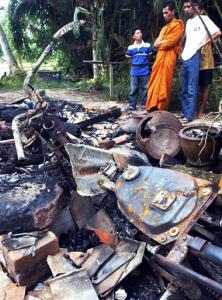
A Thai monk, center, looks at the ruins of a temple burnt by suspected Muslim separatists in Pattani Province, south of Bangkok, Sunday, Oct. 16, 2005. About 20 suspected Muslim separatists stormed a monastery, hacked an elderly Buddhist monk to death and fatally shot two temple boys Sunday in southern Thailand, police said. Six other people were killed in separate incidents across Thailand's three southernmost provinces, where more than 1,000 people have died in an insurgency that flared early last year. (AP Photo)

Early yesterday, about 15 armed men stormed Wat Phromprasit temple at tambon Ban Nok of Panare district. They attacked four spots in the temple ground. The first was at a single-storey monk's living quarters made of wood.

Two charred bodies belonging to temple boys Harnnarong Kham-on, 17, and Sathaporn Suwanrat, 15, were found inside. Spent shells of automatic rifles were scattered near the bodies.

Police believed the attackers broke into the living quarters and shot the teenagers before setting fire to the bodies. The fire consumed the place.

The second spot was another monk's living quarters where the partially burned body of Phra Phisu Kaew Phanjaphet, 76, was found in a pool of blood.

He had been beaten over the head with a hard object and hacked at with such force that it almost severed his neck.
For the religious significance of the attempted beheading, see below. The article continues:
The monk was a native of Panare district.

The fires took an hour to put out.

The third spot was the chapel. Parts of the door panels were torched by the attackers who also vandalised the altar. A statue guarding the entrance was ravaged.
The description doesn't mention which parts of the door panels were torched, but I suspect, based on the desecrated altar and damaged statue (likely of the genius of the temple), that the door had probably been decorated with images of gods or other religious iconography.

Earlier this year, the terrorists were targeting schoolteachers and students. From AsiaNews (July 25):
At least two men dressed as students yesterday entered a school in southern Thailand and killed a teacher in front of his students. This was revealed by police today. Suspicion has fallen on separatist Islamic militants: police believe the bloody murder of Prasarn Makchu was in revenge for the arrest of four suspected insurgents in Ban Salo on 20 July.

The 46-year-old teacher was shot in the head and in the back while he was teaching at Ban Buerang school in Rueso-Narathiwat road, where he had worked for the past 20 years. [...]

Teachers are among the main targets because they are held to be vehicles of transmission of Buddhist culture. [...]
Besides attacking unarmed monks and shooting teachers in the back in front of their classes, what else have the terrorists been doing to maximize the amount of fear they cause?

For one, they haven't just been targeting the teachers — they're also after their relatives. Again from AsiaNews (May 23):
Islamic militants in southern Thailand have apparently started to target relatives of Buddhist teachers. Police in the province of Narathiwat said Somboon Ratchsuwan, 69, the father of the director of a local school, was killed while driving his motorcycle with his wife riding pillion. The woman was injured. Both were Buddhists. The police said they believed the "murder was the work of Islamic militants".

Meanwhile, yesterday, more than 100 schools in the three Muslim-majority southern provinces closed because of poor security in the zone. On 19 May, still in Narathiwat, masked men kept two teachers hostage for three hours. The kidnappers demanded the release of two Muslims arrested in connection with the killing of two soldiers at the beginning of the year. The authorities did not give in to their request and the women were beaten. One of the two, Juling Ponggunmul, is in a coma.

Tawat Sae-ham, head of a teachers’ union, said there is a drive under way to "do everything possible to eliminate the Buddhist minority" from the provinces in the south. Tawat said "schools will remain closed all week because teachers don't believe they have any security".
Another thing the terrorists have been doing is planting bombs in busy marketplaces. From AsiaNews (May 10):
A bomb hidden in a motorcycle exploded in a busy market in Thailand's restive Muslim south on Wednesday, killing two Buddhist women and a soldier and wounding 13 shoppers, police said.

Both women were teachers and one was three months pregnant, police said. They said the soldier, also Buddhist, died on the way to the hospital.

"The bomb was hidden in a motorcycle that was parked next to a truck bringing soldiers to the market to buy their daily stuff," police Colonel Somporn Meesuk said from the scene in the province of Pattani.

The truck was parked in front of a small restaurant where people were queuing up to buy food, he said.
While the terrorists are specifically targeting monks and teachers, they've also been inflicting indiscriminant damage upon random civilians by planting bombs in places such as markets, banks (August 31), karaoke bars (November 6), and car and motorcycle showrooms (November 9).

The campaign of terror is apparently working. Buddhists are leaving the southern provinces in droves. From AKI (November 10):
The entire Buddhist community in two villages in the majority Muslim province of Yala in southern Thailand have abandoned their homes and have no intention of returning for fear of attacks. According to reports in the local media, 122 people, or 52 families, have taken refuge in a nearby Buddhist temple of Nirotsangkha-ram over the past two days. Many have brought only the bare necessities with them, relying on the generosity of the local population for food. [...]

According to the latest census information gathered in 2000, Muslims represent 69 percent of the 415,000 residents in Yala, while some 88 percent of the 600,000 residents of Pattani are Muslim and in Narathiwat, 82 percent of the 662,000 residents follow the Muslim faith.

At the national level however, Muslims count for only 4.6 percent of the 65 million people living in Thailand.

The families who have fled the Muslim majority areas are from the districts of Than To and Bannang Sata, which are located in Yala. Despite recent overtures by the new Thai prime minister Surayud Chulanont to the Muslims in the south, the number of attacks carried out by pro-Muslim rebels groups in the area have increased. [...]
It's hardly accurate to call the terrorists "pro-Muslim", since Muslims who happen not to share their worldview have also been victims of their violence. But Buddhists, who make up only about one fifth of the population in those provinces, have suffered the majority of the casualties.

From the International Herald Tribune (November 12):
Suspected Muslim insurgents opened fire early Sunday at a tea shop in restive southern Thailand, killing one person, as attackers elsewhere burned down a Buddhist villager's home, police said.

Two hooded gunmen fired from motorcycles at the tea shop in Narathiwat province's Rue So district shortly after midnight, killing a 30-year-old male customer seated at a table with his brother, who was injured, said police Lt. Kuma-aen Sanya. [...]

Many Buddhists have moved out of the troubled area, while those who have remained often live in fear.

Over 120 Buddhist villagers in Yala province have sought refuge since Thursday at a Buddhist temple after some of their family members were killed and their houses were burned down by suspected insurgents.

Arsonists destroyed the home of a Buddhist man Saturday night in the Muang district of Yala province, while he was out guarding a nearby Buddhist temple, police said.
The caretaker government, which was installed following a military coup on September 19, has promised to take a conciliatory approach towards the terrorists. From Yahoo News (November 8):
Thailand's army-installed premier visited the troubled Muslim-majority south, saying he supported the Islamic way of life but ruling out separation from the mainly Buddhist kingdom.

[...]

The premier [Surayud Chulanont], who was appointed after a bloodless September 19 coup, told foreign correspondents late Tuesday that the only condition for peace talks with insurgent leaders in the three restive southern provinces was that they drop any demands for independence.

"There is only one condition. No separation," he said, making it clear that a ceasefire was not a prerequisite for negotiations.

"That is the only condition we have ... we cannot accept separation of our land anywhere, this is the rule of the land, we are not going to be divided."

Surayud however added that granting a certain degree of autonomy could be discussed and stressed that he respected the Muslim way of life.

"They should have the Islamic law in practice, Sharia, because of the way they are dealing with normal practice in their life is completely different from us," he said.
The offer on the table seems to be that Muslims in southern Thailand can be governed by Islamic law in personal matters such as marriage and inheritance, similar to the system in India, if they drop demands for political independence. But these conciliatory gestures by the government seem to have had no effect.

From The Nation (via The Buddhist Channel, November 10):
Violence in the three southernmost provinces have displaced a number of Buddhist residents over the past three years but the Wednesday exodus was the first of its kind in which an entire community packed its belongings and fled.

In September 2005, at least 131 Muslim families from Narathiwat had also fled to northern Malaysia where they are currently residing in a government compound. The incident led to a diplomatic fallout between Thailand and Malaysia, especially after the latter permitted the UN refugee agency to interview the displaced villagers.

Local residents said the violence has restricted their travel and activities, and taken a tremendous toll on their livelihood.

Wednesday night's exodus marks a setback for the government's policy of reconciliation as none of Prime Minister Surayud Chulanont's goodwill gestures have been reciprocated by the militants who have been accused by authorities of being behind the daily violence in the three Malay-speaking southernmost provinces.

Attacks on soldiers, as well as civilian targets, continue unabated and the government is hard pressed to come up with a quick solution for a problem that many analysts say could take a generation to resolve.
As the above article indicates, the government is not without fault in this conflict. They have been indiscriminantly heavy-handed in some instances in the past. They have also not done enough to convince the common Thai Muslims that the terrorists are as much of a threat to them as they are to Buddhists or to the Thai state — if not more so.

However, whatever real grievances the Muslims in southern Thailand may have, the terrorists have essentially lost the sympathies of everyone else in the rest of Thailand. Attacks on police officers, soldiers, government officials, and other symbols of the state are not unexpected in an insurgency. But by murdering monks, teachers, women, children, and other civilians, the terrorists have shown that they consider the conflict to be primarily ethnic or religious, rather than political, in nature.

Whenever Muslims commit acts of terrorism, there are always commentators who point out that it is the work of only a few "extremists" or "radicals" and that their actions should not reflect on all Muslims. Of course, no one should be held accountable for events over which they have no influence or control. The problem is that there is an attitude that is very prevalent in Muslim societies that Muslims should always take the side of Muslims rather than non-Muslims in any conflict, regardless of right or wrong. Any actions that the victims of Islamist terrorism undertake to retaliate, or to prevent further acts of terrorism against themselves, are portrayed as a persecution of Muslims or an attack on Islam. This portrayal is used by the Islamists to inflame other Muslims to draw them into the conflict.

We read, for example, that the killing of a teacher, while he was teaching in front of his students, is "in revenge for the arrest of four suspected insurgents". How does killing a teacher and traumatising children in any way avenge any kind of wrong? Or we read that the terrorists take two female teachers hostage to secure "the release of two Muslims arrested in connection with the killing of two soldiers". When the authorities refused, the women were beaten, one of them into a coma. How were the authorities wrong to arrest suspects wanted in connection with the killing of soldiers, and even if they were, how does kidnapping and beating up women right that wrong?

By behaving in this manner, the Islamists are ensuring that the situation snowballs out of control. Muslims are polarised so that those who had been co-existing peacefully with their non-Muslim neighbours are either forced to side with the Islamists, or be driven out or killed. This pattern has repeated itself throughout history in every place where Muslims have been a sizeable minority in a society. In the past, this behaviour has resulted in the seizure of a considerable amount of territory for Islam, at the expense of impoverishing or destroying the pre-existing societies.

So this pattern of behaviour is nothing new. The Islamic invaders of Central Asia and the Indian subcontinent also targeted monks and teachers and razed non-Muslim places of worship to the ground. Pakistan, Bangladesh, and many of the countries of Central Asia used to be predominantly Buddhist or Hindu. And while Hindus could at least claim to worship "one God", albeit under different names, it was considerably more difficult to reconcile Buddhism with monotheism, when the Buddha specifically rejected the belief in a personal creator God. Buddhists were classified as idolators and were given the choice of conversion, departure, or death. The looting and destruction of important Buddhist monasteries and universities by the invaders also precipitated the decline of Buddhism in India.

The violent and heedless behaviour of the Islamists, and the departure of the Buddhists, will only result in the impoverishment and debilitation of the southern Thai provinces and their inhabitants. This has been the outcome in every place where Muslims have driven out Buddhists by force. Furthermore, the terrorists claim to be fighting for their sovereignty, but they are in fact unwittingly acting as the agents of Islamic imperialism. Muslims – not only in Thailand, but worldwide – are trapped in a vicious cycle, labouring under the delusional belief that acting like a bunch of 7th Arab warriors (but armed with modern technology) is the path to spiritual and material prosperity, while carrying out actions that harm others as well as themselves. There is a word for this cycle in Buddhism: it is called "samsara".

In order to defeat the terrorists, the Thais must break the cycle by learning the right lessons from the Islamic invasion of India.


The Bangkok Pundit blog, which is an excellent place to learn about the political landscape in Thailand, is running a series of posts on the changing nature of the insurgency in the southern provinces. From the first part of the series (the emphases are from the original post):
Prior to January 2004, the main target of attacks were police and military officials in rural areas [...] However, since January 2004, there has been a noticed shift to also include attacking Buddhist monks/symbols, teachers, and civilians (Buddhists and Muslims) in urban areas (The Nation). [...]

It is not just that the insurgents have changed their target of attacks to urban areas, but that the nature of the attacks has also changed. Beheadings, as the story above illustrates, are becoming a more regular occurrence since the upsurge in violence in January 2004. Coordinated bombings have also become more frequent. These tactics, particularly beheadings, appear to be copied directly from Iraq.

This violence instills fear amongst the population and I believe why the activities of the insurgents can be described as terrorism - most of the acts would fit within the definition of a terrorist act in the Criminal Code.

The changing nature of the insurgency shows a shift from an ethno-nationalist insurgency towards jihad.
The second post of the series examines the targeting of Buddhists by the Islamist terrorists:
Buddhist temples have also been attacked and bombed (The Nation). In one violent incident in October 2005, newspapers report that 20 gunmen entered a Buddhist temple, hacked an elderly monk to death then opened fire on the monk's dwelling killing two temple boys before setting the temple on fire (The Nation).

Just after this attack monks became more vocal in their protest - not in favour of a softening of the government's approach either [...] It is not just Buddhist temples, but Buddhist monks have also come under attack. In 2004, a number of Buddhist monks were 'hacked to death' (The Nation). Buddhist monks have also been attacked when they collect alms and many state that they are fearful and no longer willing to travel freely through southern communities to collect alms (US State Department). [...]

Buddhists make up a majority of the victims of the violence in the 3 southern border provinces [...] Buddhists are also dying in increasing numbers. For the first 6 months of 2005, 111 Buddhists were killed, this rose to 141 for the first 6 months of 2006. However, for Muslims the opposite occurred, the death toll decreased from 208-183 (Deep South Watch).

It is not just the number of Buddhists who have been attacked, but also the way they have been killed. In May 2004, one Buddhist was beheaded and a note left on his body warning of sectarian violence (Strait Times). In a 5 week period in June-July 2005, a further 9 Buddhists were beheaded (Washington Times). Killing by beheading is new phenomenon for the 3 southern border provinces. A government minister has stated that intelligence suggests the beheadings were copied from Iraq (Washington Times). [...]
This, of course, just raises the question of where the jihadists in Iraq got the idea of beheading their victims from. The Islamist terrorists in both Iraq and Thailand are, in fact, just imitating the examples set by the first Muslims and carrying out the rulings of the classical Islamic jurists (see, for example, these articles from Slate, FrontPage, and The Middle East Quarterly).

The post from Bangkok Pundit continues:
It is widely believed by Thai government officials (The Nation) and foreign analysts (The Nation) that Buddhists are deliberately targeted to raise sectarian tensions. One senior Thai government official has described the situation as 'ethnic cleansing' as Buddhists have been told to leave the 3 southern border provinces under the threat of violence (The Independent). For example, Amnesty International report citing a message which stated: "Thai Buddhists if you are still on our land we will kill you all. Get out from our land. Otherwise you will eat bullets again." (Amnesty International ) It is estimated that up to 10% of Buddhists living in the 3 southern border provinces have left the southern border provinces (Zachary Abuza).
The Islamist terrorists are, by their own admission, embarking on a campaign of genocide against the Buddhists.

Some other relevant posts from Bangkok Pundit:For more background on the Muslim secessionist movements in southern Thailand, see this report by the Jamestown Foundation: "A Breakdown of Southern Thailand's Insurgent Groups".

南無阿彌陀佛

Sunday, November 12, 2006

Buddhist Dalit family murdered in India

A horrific story from Kherlanji, India (from an editorial in The Buddhist Channel):
Like many Indians, their hopes of a good life were basic: a decent education, a life that was lived with self respect and a livelihood which disturbed no one. But in India, Surekha and her family were tortured for many years because they chose to live the "basic life". The reason – because they were Dalits, untouchables in the eyes of Hindu purists whose status are merely better than animals.

On September 29, 2006, in the town of Kherlanji, near Nagpur - a new center of Buddhist movement in India - Buddhists Surekha and her daughter Priyanka were beaten, paraded naked and gang-raped in full public view for an hour before they fell dead.

[...]

We would like to appeal to the international Buddhist community to please use your connections and networks and forward this information to all Human Rights Organizations and Government and Non-Government Agencies.

It is time that the suffering endured by the multitude of Dalits - the so called untouchable caste of India - be highlighted to the international community so that the voice of reason can be pressed upon the Government of India to put a "practical" stop to such inhumane act once and for all.

For more information on how you can help, or to enquire about the Dalit situation, please contact the following:

The Jambudvipa Trust
www.jambudvipa.org
'Manuski', Deccan College Rd
Tel/Fax +91-20-2669 6812  /  +91-98506 66479
Yerwada, Pune
411 006, India

The Ambedkar movement
www.ambedkar.org
The incident described is extremely sickening. What is there to say?

The village where this incident occurred is variously spelled Kherlanji and Khairlanji. In wonder if it's the same Khairlanji mentioned in this post?

Here is a smattering of news articles and blog posts about the crime and the protests sparked by it:
And this map from Atrocity News showing the attacks on Dalits and Buddhists in India is simply chilling:
There are 231 rapes and 51 murdered last year. The families are helpless, only hope is help from world community !
Every hour two Dalits are assaulted,
Every day three Dalit women are raped,
Every day two Dalits are murdered & two Dalit houses are burnt in India….”
(Report of the Ministry of Welfare of the Government of India, 1992-1993)
The government of India must be held accountable for these crimes, which are being committed by its own citizens against its own citizens.

南無阿彌陀佛

"Reformation of Islam" aberrant?

Someone (based on the context, a Muslim) calling himself (or herself) "God's Servant" left a comment yesterday on this post from October:
There is no reformation of Islam, it's impossible. Actually Islam is declining, modern time of Islam existed 14 centuries ago while other civilizations and religions were in darkness, that's why the expression "reformation of Islam" is aberrant.

Nowadays, even muslims don't know nothing about their religion and they are the first victims of fanatism and terrorism existed in muslim countried before existing in the west.

Islam is like money, you got to work hard to find the truth.
I didn't want to reply just in that post, since it's over a month old, so I'll reply here in this new post. I specifically want to address this claim:
modern time of Islam existed 14 centuries ago while other civilizations and religions were in darkness
This is a myth perpetuated by apologists for Islam, and it is simply not true. Persia (Iran), India, and China were all enjoying relatively high degrees of civilization at the time of the advent of Islam. Buddhism had been transmitted from India to China over the previous several centuries and was fomenting an intellectual revolution along its routes of transmission. The disintegration of many of these highly developed societies was in fact caused by the relentless waves of Muslim invasions.

One of the major reasons for the initial successes of Islam was that the early Muslim conquerors assimilated the civilizations of the peoples it conquered. The first Arab-Islamic conquests were facilitated by the fact that the Byzantines and the Sassanians had exhausted themselves fighting against each other. When the Muslims conquered Persia, they essentially adapted the pre-existing structures of governance and methods of statecraft of the Persians. They recruited Persian scholars to their cause and employed many Persian administrators to run the Islamic empire. They similarly assimilated the knowledge of various smaller communities living under Islamic rule by the appointment of their scholars to court and through the conversion of their members to Islam. (Try looking into the ethnic backgrounds of the most influential philosophers, scientists, and other scholars in the Islamic world at this time.)

If it had not been for Persian administrative practices and experience, Greek medicine and philosophy, Indian mathematics and metallurgy, Chinese papermaking technology, and a host of other sciences and technologies captured or learned from others — not to mention Jewish, Christian, and Zoroastrian religious beliefs and practices — there would have been no Islamic civilization. The Islamic empires were built upon ideas copied from neighbouring civilizations and with the wealth obtained through their conquest and plunder.

Yes, the Muslims were at one time leaders in civilization, but it wasn't quite 14 centuries ago. It was several centuries afterward, after Islam had established itself more or less securely in Persia and Central Asia and was making its way across India. But as the Islamic empires expanded and dhimmi populations were converted to Islam, the policy of continual military expansion pursued by Islamic rulers started to become uneconomical. At the same time, influential Muslim theologians popularized the idea that Islam represented the height of civilization and that other societies were in darkness, and Muslims began to cease learning from other cultures. These internal developments, coupled with external events such as the irruption of the Mongol hordes, marked the beginning of the decline of Islamic power.

The myth that the first generation of Muslims had attained the pinnacle of civilization seems to explain the success of the Islamic empires relative to their competitors at this time, as well as their subsequent decline. I suppose that's why it's popular among Muslims. But an examination of the historical evidence shows that this myth is false. Belief in this myth – which can only be described as hubris – is precisely what led to the downfall of Islamic societies to begin with, and is one of the major factors preventing Islamic societies from adapting or developing modern concepts of individual rights.

Islam is indeed in decline, and has been for centuries. Most of the Islamic countries in the world cannot support themselves and would collapse if not for oil (Saudi Arabia, Iran), massive amounts of foreign aid (Egypt, Pakistan), or a sizeable non-Muslim population that is wealthy and industrious (Indonesia, Malaysia). This state of affairs will not be sustainable for very much longer. You wrote that 'the expression "reformation of Islam" is aberrant', but the way things are going, the alternative to reformation is destruction.

You seem to be suggesting that the only real Islam was practised 14 centuries ago and that what is needed is not a reformation but a return to some pristine ideal. The problem is that this ideal exists only as a myth, invented centuries after the fact. To base one's actions on such a false view of the world is to act under the influence of ignorance (or delusion), one of the "three poisons" in Buddhist philosophy. What is needed among Muslims is not more blind adherence to religious dogma and mythology, but a genuine understanding of real history.

(By the way, I skimmed through your blog. It seems to consist of nothing more than parroting other people's poorly reasoned Islamic apologetics. For a critic's view of these arguments for Islam, I recommend a visit to Freethought Mecca.)

南無阿彌陀佛

Saturday, October 28, 2006

Australian Muslim preacher compares women to meat, condemns Christians and polytheists to Hell

In this previous post, I mentioned Sheikh Taj al-Din al-Hilali [شیخ تاج الدین الهلالی] (parts of his name are variously written as Tajeddin or al-Hilaly), the leader of the Lakemba Mosque in Sydney, in connection with his reprimand of another Muslim leader, Dr. Ameer Ali, for allegedly criticising Muslims for taking a close-minded approach to religion. So the Sheikh is, shall we say, a bit of a religious hardliner.

Now Sheikh al-Hilali is in trouble for making derogatory remarks comparing women to meat during his Ramadan sermon. This weekend's edition of The Australian has a number of articles discussing various aspects of the incident.

First, the transcript of the actual sermon may be found here. In the part of the sermon that the media has focused on, the Sheikh compares unveiled women to uncovered meat left in the open, which is snatched up by wandering cats:
But the whole disaster, who started it? The Al-Rafihi scholar says in one of his literary works, he says: If I come across a crime of rape - kidnap and violation of honour - I would discipline the man and teach him a lesson in morals, and I would order the woman be arrested and jailed for life.

Why, Rafihi? He says, because if she hadn't left the meat uncovered, the cat wouldn't have snatched it. If you take a kilo of meat, and you don't put it in the fridge, or in the pot, or in the kitchen, but you put in on a plate and placed it outside in the yard. Then you have a fight with the neighbour because his cats ate the meat. Then (inaudible). Right or not?

If one puts uncovered meat out in the street, or on the footpath, or in the garden, or in the park, or in the backyard without a cover, then the cats come and eat it, is it the fault of the cat or the uncovered meat? The uncovered meat is the problem! If it was covered the cat wouldn't have. It would have circled around it and circled around it, then given up and gone.

If she was in her room, in her house, wearing her hijab, being chaste, the disasters wouldn't have happened. The woman possesses the weapon of seduction and temptation. That's why Satan says about the woman, "You are half a soldier. You are my messenger to achieve my needs. You are the last weapon I would use to smash the head of the finest of men. There are a few men that I use a lot of things with, but they never heed me. But you? Oh, you are my best weapon."
For some reason that is unknown to me, the Sheikh seems to really have it in for Canadian women in particular:
On the issue of stealing, when the man is responsible for earning. He's responsible for the expenses, for the food and water. He is the one who has to pay the rent, he is responsible for the alimony, he is responsible for feeding his children. Maybe circumstances forced him and Satan tempted him, and there is a woman like hell behind him; she never has enough. She wants to change the furniture, change the lounge every year. And behind every man who is a thief, a greedy woman. She is pushing him. Not our women in Australia, the women of Canada. The hall up there is full. They are the women of Canada and Mexico, the ones who encourage their men - to do what? Go! Get me! And no matter how much he brings her, she wants more. She wants to change the car, and change ... Of course, the woman keeps demanding from her husband more than his ability. Either she will tell him to go and deal in drugs, or to go and steal. What's more than that? Spend as much as you have! You know your husband, upside down! If you demand from your husband more than his ability, then what does that mean? Who is the one who would have to become a mafia? A gangster? And steal cars? And smash banks? And deal in the "blue disease" (drugs)? Who is the one who commits these crimes of stealing? Who? The man or the woman? It's the man.
So, according to the Sheikh, Canadian women are responsible for gangsters and bank robbers. Got it.

Most articles and commentaries have focused on the Sheikh's reprehensible comments about women. However, he also attacks Christians and polytheists, whom he lumps together into one group:
Why wasn't the verse ended with forgiveness and mercy? Because there is a crime of polytheism. God does not forgive polytheism, and forgives everything else. These people said that God took a son, these people said that divinity united with man, and the Father, the Son and the Holy Spirit, and they will see mercy? They will never see it, not him or his father. Not dad or mum. No one will see mercy, of those who believe in polytheism. Our Master Jesus knows that the crime is big. And there is no appeal for it. No way the judgment can be appealed. And they will never have intercession on the Day of Judgment, because polytheism is a great injustice. If it was a simple matter, the verse would have ended with "For God is forgiving, merciful". But it ended with "If You punish them, they surely are Your servants. And if You forgive them." They'll never see it. You will be wise, You will rule, then they'll cop it.

Those who disbelieve amongst the people of the Book and the polytheists, where will they go? Surfers Paradise? Gold Coast? Where? To the fire of hell. And not part-time, they'll be in it for eternity. What are these people? The most evil of God's creation on the face of earth. The issue is clear. So, the verse should be ended with what? "For God is mighty, wise." Not "For God is forgiving, merciful".
What kind of god is so pathetically weak that he has to resort to threats of violence to keep his believers in line? It is said that a man creates his god in his own image, and by al-Hilali's description of God, we know just what kind of man he is.

The idea that blasphemy should be treated as a crime, or that any crime against an omnipotent being is even possible, is patently absurd. As some atheists say, "blasphemy is a victimless crime." Or, as Mark Twain quipped:
Blasphemy? No, it is not blasphemy. If God is as vast as that, he is above blasphemy; if He is as little as that, He is beneath it.
The absoluteness and arbitrariness of God is one of the major philosophical problems that Buddhism has with monotheism. In Buddhist philosophy, all beings are subject to the same laws of the universe, even the highest gods. This means that the gods, no matter how powerful they might seem, still suffer from decay and even death. Furthermore, their actions produce karma, and it would be impossible for a god to burn sentient beings in a fire (for eternity, no less!), without incurring tremendous negative consequences for himself.

That is why no Buddhist can take seriously the idea that moral conduct should be motivated by "the fear of God" (i.e., really, the fear of punishment). To a Buddhist, placing beliefs above actual conduct seems like a case of misplaced priorities. How can not believing in God, or believing in multiple gods, be a "worse crime" than actually hurting other living beings, by murder, theft, sexual misconduct, lying, etc.?

Sheikh al-Hilali is seriously out of step with the times, as is a segment of the Muslim community who hold views similar to those of the Sheikh.

Also from The Australian:南無阿彌陀佛